Apartments, Lisbon

A distinctive corner tower

There are some apartment blocks on the Avenida António Augusto de Aguiar which have excellent Art Deco reliefs over their entrances. These are in the Saldanha district of Lisbon and belong to a group which probably all had the same team of architects.

The supportive family

The first is a building located at Avenida António Augusto de Aguiar 15, which features a corner tower that has a large, carved, stone relief of a family group above the entrance at its base. The mother and father are portrayed giving support on either side of the child.

The lovebirds at #9

Nearby at Avenida António Augusto de Aguiar #9 and #7 are two other related buildings with excellent street level carved, stone reliefs. The one at number #9 features a courting couple of birds, and at #7 a reclining woman lies wreathed with draperies. A date and the sculptor’s name is just visible on the latter at bottom left: 1942, Leopoldo.

Asleep and dreaming, perhaps?

Apartments, central Lisbon

A balanced exterior

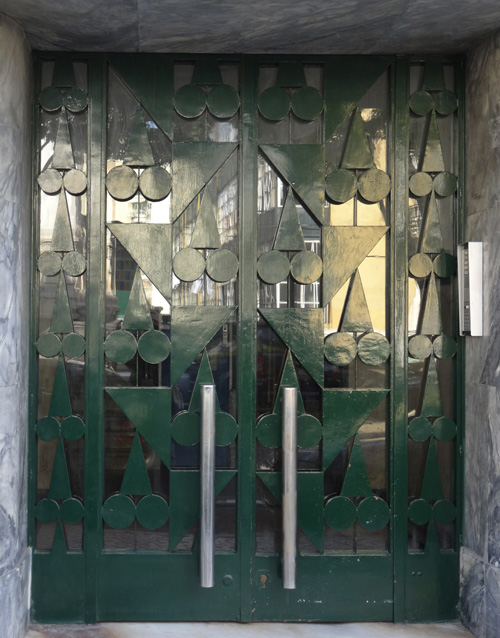
This five-storey apartment block constructed in 1937 has a façade which has a perfect balance of horizontal and vertical elements. Located in central Lisbon, the architect was Cassiano Branco who also designed the Victoria Hotel there. He used shallow, rectangular setbacks emerging from a central axis formed of three continuous bevelled bars rising as a fin from just above the entrance up to the roofline. In contrast to the purely rectilinear façade the entry doors are composed of playful triangles and circles.

A marble-lined entry to the building

Albufeira, Portugal

A simple but effective façade

A modest, Art Deco bungalow in the seaside city of Albufeira, in the Algarve region of southern Portugal. There is a date at the top centre of the building of 8 October, 1953, and below this a series of diagonals making what could be either a zigzag or a pair of mountain peaks. Underneath all of this is a five-pointed star.

Horizontal and vertical elements at the sides

Victoria Hotel, 170 Avenida da Liberdade, Lisbon

Startling modernity in Lisbon in 1936

The Victoria Hotel was designed by the tremendously talented architect Cassiano Viriato Branco, who also designed other landmark, mid-war buildings in Lisbon such as the Teatro Éden. Work began in 1934 on the project and it was completed in 1936, though this was only part of the architect’s concept.

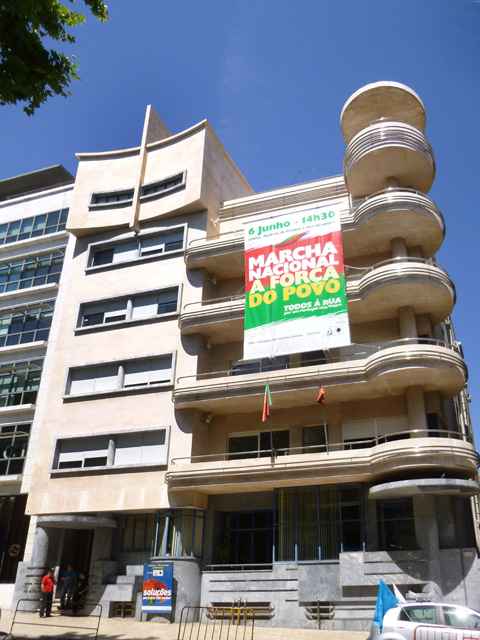
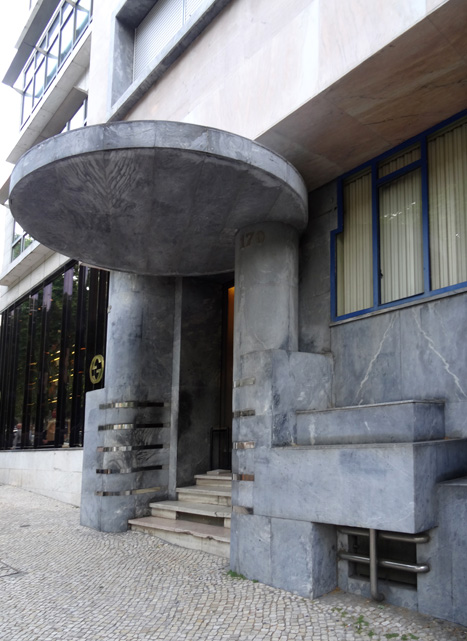
The building had a number of features, including a facing of pink marble, but the most eye-catching one was certainly the circular balconies stacked along the corner of the six-storey building. These were cleverly echoed with a round porch projecting out above the entrance.

By the mid 1970s the hotel had become run down and neglected which engendered an attempt to revive it. Nothing came of this in the end and the building was bought in 1985 by the Lisbon branch of the Portuguese Communist Party, and it remains their regional headquarters.

A striking entrance

Avenida Sidonio Pais 18, Lisbon

Façade of Avenida Sidonio Pais 18

Sitting just opposite Lisbon’s expansive Parque Eduardo VII (Edward VII Park, named in honour of the UK monarch who visited Portugal in 1903), the building at Avenida Sidonio Pais 18 is one of a cluster of contiguous structures which probably all had the same team of architects. These are most likely buildings from the 1940s and nearly all of them have at least a sculpture over the main entrance.

Avenida Sidonio Pais 18 is a modern building with a Classical touch not only in the window pediments on the exterior but also in its ambitious sculpture programme. On either side of the front entrance are vertical groups of four carved, stone reliefs. These depict in fine Art Deco style eight of the nine Muses, those Classical personifications of the arts and knowledge including Clio, the Muse of history and Euterpe, the Muse of flutes and lyric poetry.

Stone reliefs of the Muses by the front entrance
Clio, the Muse of history
Euterpe, the Muse of flutes and lyric poetry

County Courthouse, Faro

County Courthouse, Faro

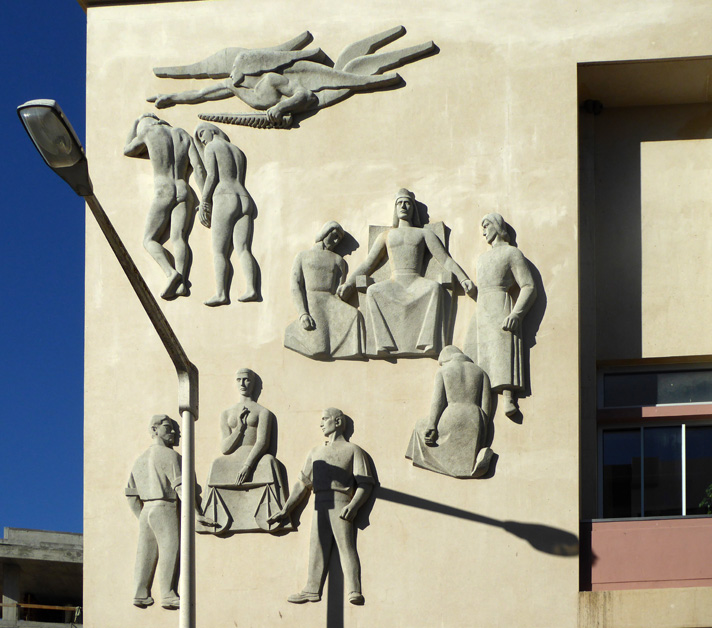
This is the Tribunal Judicial da Comarca de Faro – Secção Central, or the County Courthouse of Faro, Central Section. It is located at Avenida 5 de Outubro 10, in Faro, the capital of the Algarve region at the south of Portugal. The sculptures show a sequence from divine justice, with Adam and Eve expelled from the Garden of Eden, then a King dispensing justice from his court, to modern law with a claimant and a respondent in front of the symbol of justice.

A brief history of law

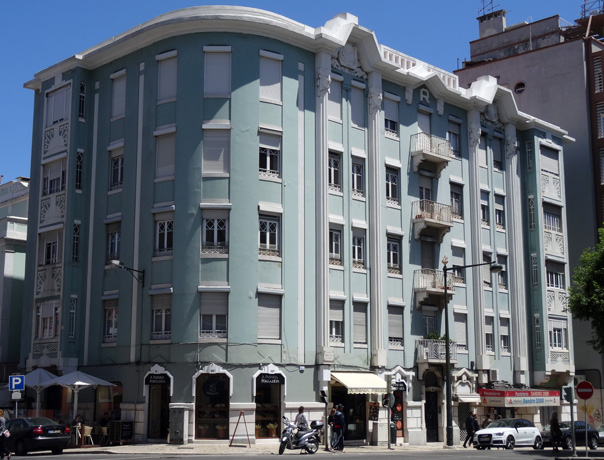
Avenida António Augusto de Aguiar 100, Lisbon

Avenida António Augusto de Aguiar 100 curves round the corner.

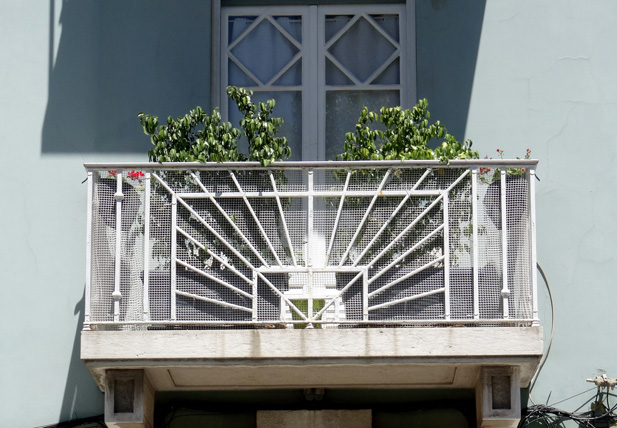
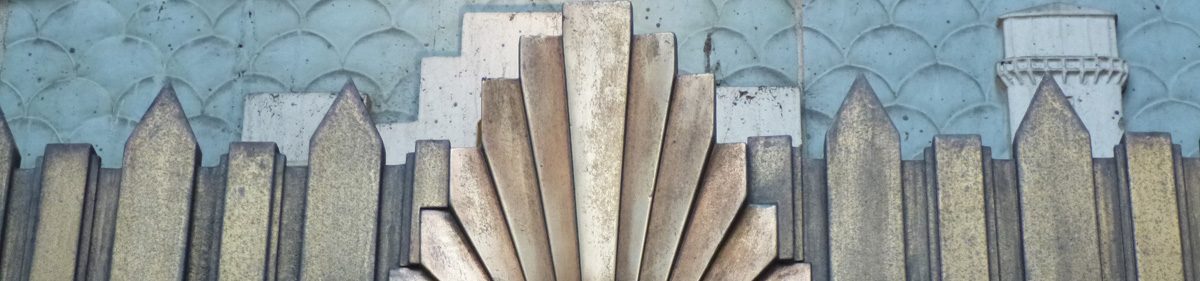
A striking building in Lisbon’s Saldanha district, this five-storey mix of retail and residential sits on the corner of the major artery that is Avenida António Augusto de Aguiar and the Rua Augusto dos Santos. Among the Art Deco details featured on it, highlighted in white against the prevailing green, are three different geometric sunbursts, one in wrought iron on a balcony and the other two below windows.

A metal sunburst.
Two similar sunbursts.
A metal window grate.

Rua de Sá da Bandeira 630, Porto

Mixed usage building – retail and residencial.

Up in the north of Portugal you can find the beautiful city of Porto. Here is an apartment block in the city located at Rua de Sá da Bandeira 630. Below it at street level are shops and the Garagem de Sá da Bandeira, a car park, whose sign is on the far right. The building is well proportioned, if a little boxy. The only curved elements are the corbels at the base of the two continuous vertical windows used for the stairwells.

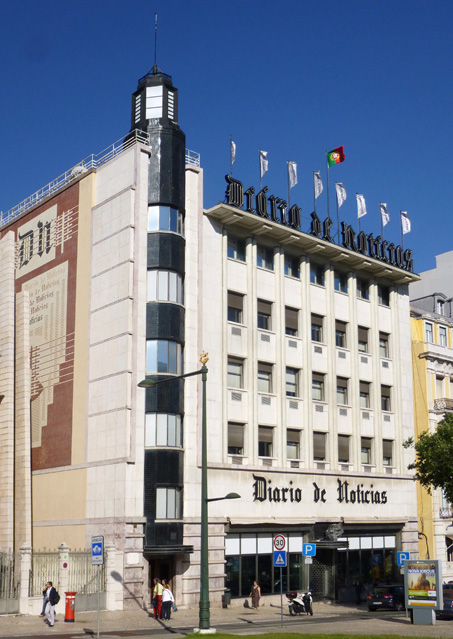
Diario de Noticias, Lisbon

A popular daily newspaper was produced here.

The daily newspaper Diario de Noticias has been published in Lisbon since 1864. This mid-twentieth century building, designed by the architect Porfirio Pardal Monteiro, won the Portuguese ‘Premio Valmor’ architectural prize in 1940. Located on the prestigious Avenida da Liberdade in the Rossio district, it united in one location all of the various functions of the newspaper, from editorial all the way to subscriptions, printing and distribution. It was listed as a National Monument in 1986. Note the embedded black tower on the left, complete with a lantern at the top, together suggesting a lighthouse. Recently it has been converted into luxury apartments.

The façade facing the Avenida da Liberdade.

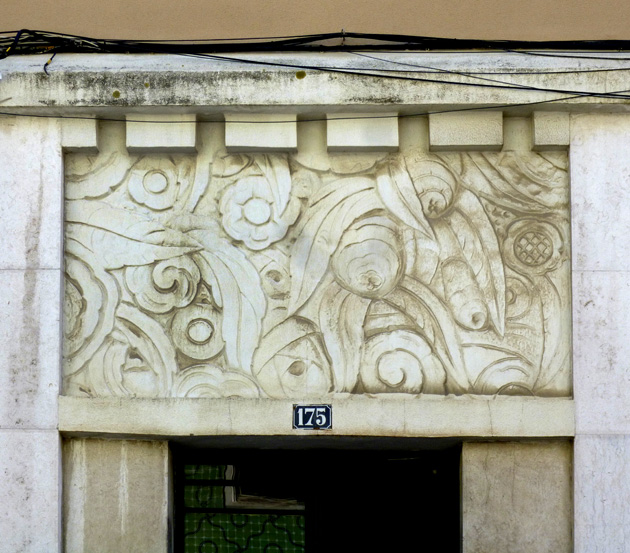
Rua do Salitre 175, Lisbon

A French influence from the architect.

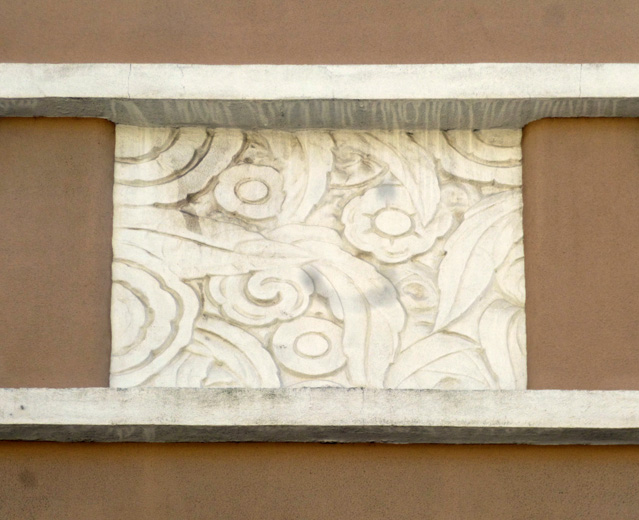
Here is a six storey apartment block located at Rua do Salitre 175 in the Rato district of central Lisbon. Its key colours are brown and white, and it has angular bay window towers rising from the third to fifth floors. Another feature is the carved, stone relief panels of flower arrangements which give a nod to the French designers who evolved them. These can be seen above the central entrance then between the windows on the floors above.

Flower arrangement above the main entrance.
More carved flowers and leaves.