Charles House, Birmingham

A stepped-in tower

Emblazoned across the top of Charles House at 148 Great Charles Street in Birmingham are the letters ‘CML’ as it once housed the local offices of the Australian company Colonial Mutual Life Assurance. This company was founded in Melbourne, in 1873 by Sir Redmond Barry, who was also a judge there. His chief claim to fame as a judge was passing sentence on Ned Kelly.

Charles House stands at nine storeys in height and has some relief heads and other interesting details around the entrance. Constructed in 1939, the building was designed by the Sydney architectural firm of Hennessy & Hennessy & Co working with London’s Stanley Hall & Easton & Robertson.

Apartments, São Paulo

Brilliant Art Deco in Brazil’s largest city

This is an interesting eight storey apartment block in central São Paulo. It has a variety of period details and features slot windows and curving balconies. The neighbouring building, visible on the right in the photo below, also has curving balconies, as well as porthole windows.

Curved balconies all round

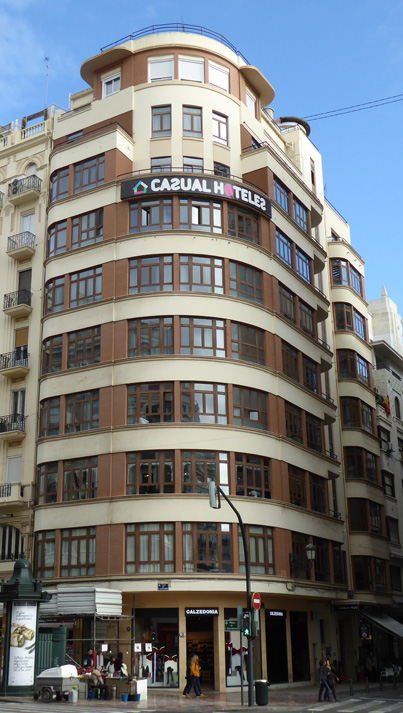
Casual Hoteles, Valencia

A curving corner

This building sits on a corner lot with its main façade on Calle Barcelonina in the San Francisco area of Valencia. Its original name was the Martí Alegre building and it was designed by the architect Javier Goerlich Lleó. A ten-storey edifice, it was constructed from 1934-1941, and curves around the ground floor, and the six above it, then stepping in with those above. It later enjoyed the name of Hotel Londres for many years before becoming part of the Casual Hoteles group.

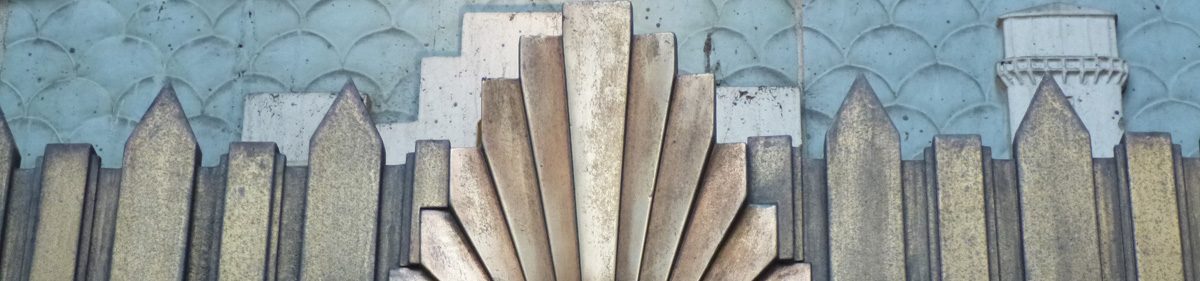
A close up of the upper façade

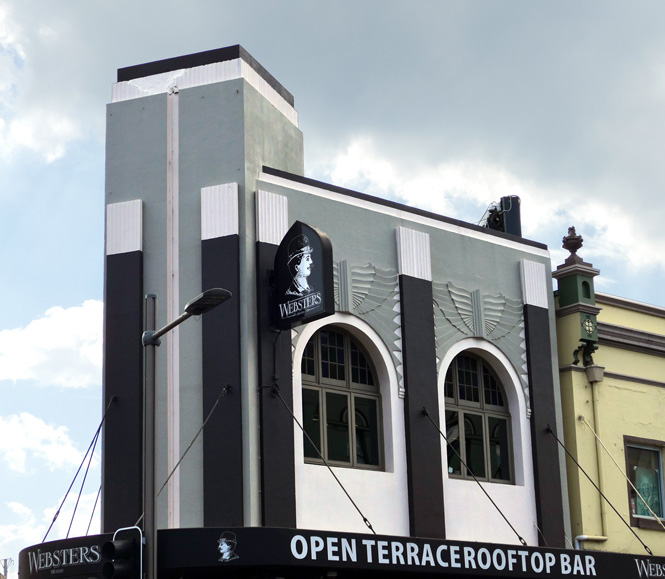
Websters Bar, Sydney

A stylish corner bar

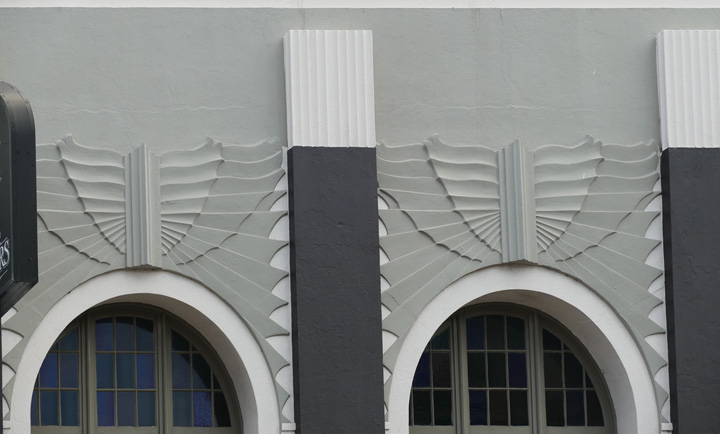
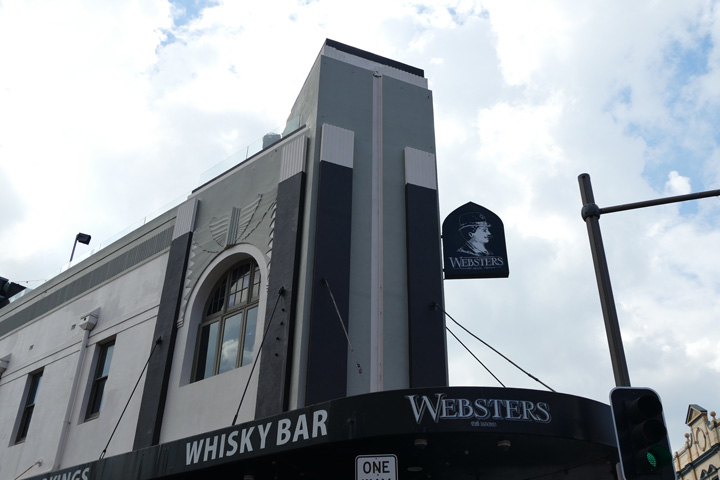
This building is currently the home of Websters Bar, a three storey building on a corner lot at 323 King Street in Newtown, Sydney. Probably constructed in the the 1930s, it features wonderful, winged motifs. There’s a chance that it was a bit more colourful in its original incarnation but the black, white and grey has been skillfully applied here to highlight the decorative features. Thanks again to Keith Barrett for providing these photos.

Highly decorative wings
Another view of the façade

Cheviot Court, Durban

A variety of windows

Global Art Deco is pleased to have another guest post from the Durban Art Deco Society. Durban is South Africa’s third largest city and has many fine Art Deco buildings, including this one.

Cheviot Court, Durban
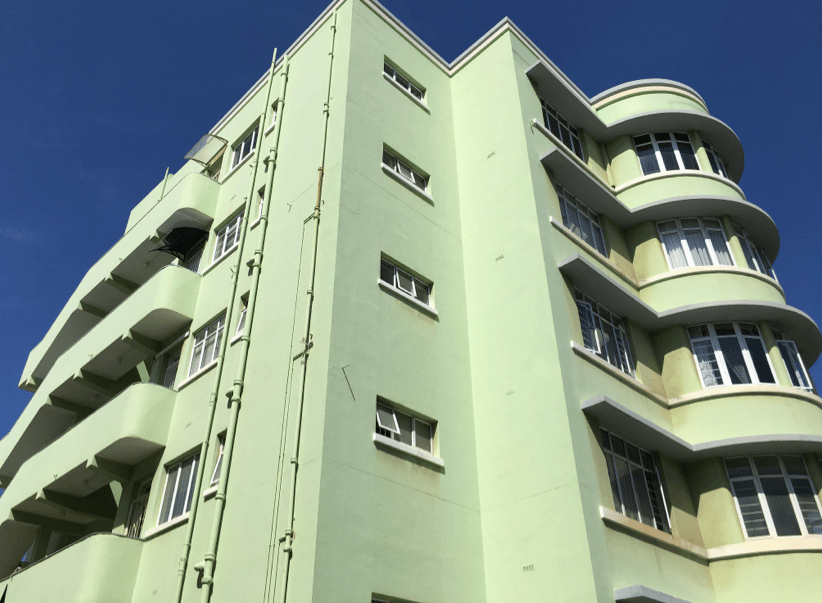
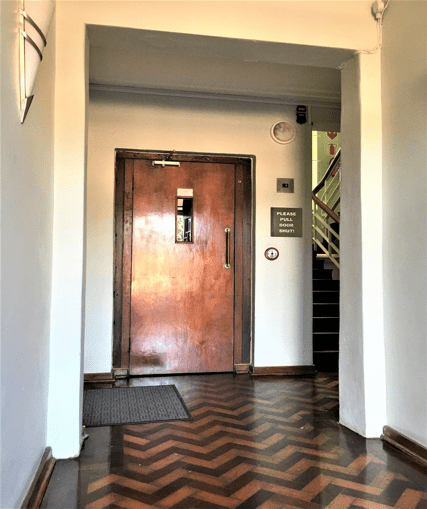
This is a striking six-storey apartment building in a prime location on the Berea Ridge, overlooking the city of Durban. Located at 676 Musgrave Road at the corner of Poynton Place, it was designed by architects W S Payne & E O Payne and constructed in 1934. The Streamline Moderne styling is evocative of the fast ocean liners, cars and aeroplanes so admired as the machine age took root in the 1930’s. The building is asymmetric, with large bay windows at right angles at the ends of each floor. A tower rises above the entrance canopy to a decorated flagpole on the skyline. Horizontal lines are created by window sills and eyeshades running the full length of the building on each floor. The entrance canopy is supported on curved-brick pillars, and leads to a simple foyer with zig-zag parquet flooring.

Photos and text © Durban Art Deco Society

Cheviot Court entrance
A view of the foyer

Apartments, central Lisbon

A balanced exterior

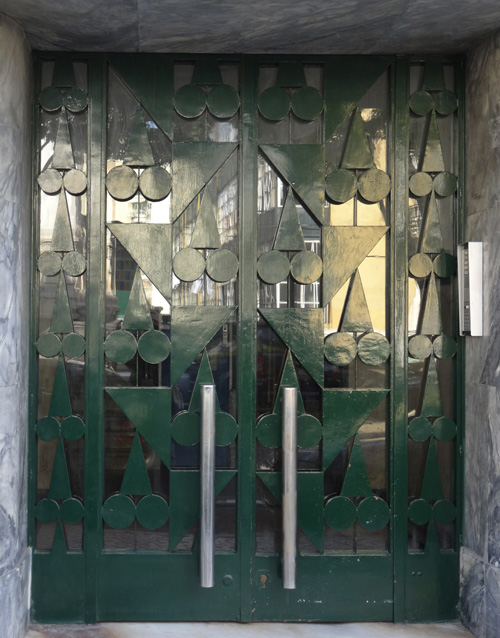
This five-storey apartment block constructed in 1937 has a façade which has a perfect balance of horizontal and vertical elements. Located in central Lisbon, the architect was Cassiano Branco who also designed the Victoria Hotel there. He used shallow, rectangular setbacks emerging from a central axis formed of three continuous bevelled bars rising as a fin from just above the entrance up to the roofline. In contrast to the purely rectilinear façade the entry doors are composed of playful triangles and circles.

A marble-lined entry to the building

Primark, Western Road, Brighton

A bold, commercial block in Brighton

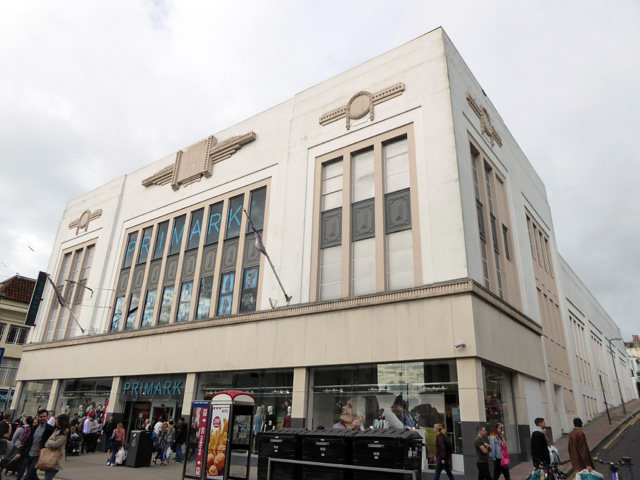
This is a large retail and commercial building currently home to Brighton’s central Primark at 169-174 Western Road. Located not far from seaside Brighton, it had previously been a C&A store and started life as a British Home Store (or BHS) in 1931. It was one of several department stores that appeared on the main shopping streets of the city during the mid-war epoch. It features some wing-like motifs across the top of the façade.

The central winged motif

Enmore Theatre, Sydney

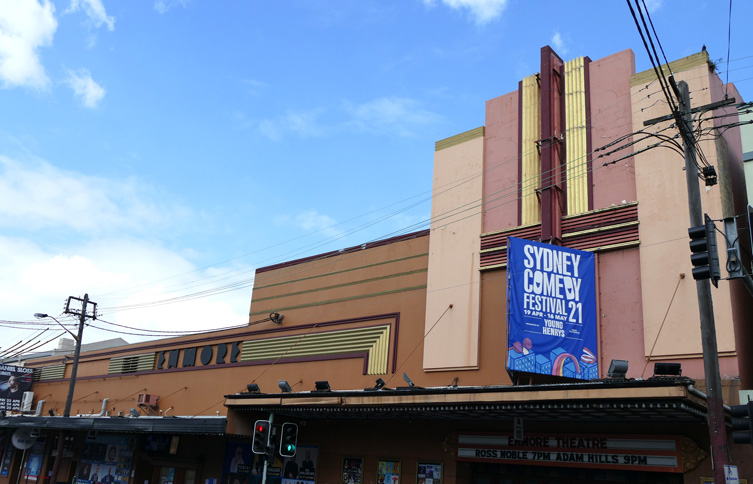
Warm colours and Jazz Age lettering

With this post we are once more off to the theatre. In fact, the Enmore Theatre is not only the longest running one in Sydney, Australia, but also the only surviving Art Deco styled theatre there. It can be found in the Newtown area at 118-132 Enmore Road and was first built in 1908, opening in 1912 as a cinema for silent movies with a concert orchestra providing their soundtracks. The Enmore was designed by the architects Kaberry & Chard and renovated in 1920, but this is a bit early for the geometric styling we see here. It was probably renovated again in the 1930s.

The Enmore is still going strong in its second century of theatre and cinema existence and can fit 1,700 seated and 2,500 standing. It has always balanced big name acts like Bob Dylan and the Rolling Stones with native Australian acts and local events. This may well have been the key to its survival as the arrival of television saw the closing and demolition of many fine entertainment houses globally. Many thanks to Keith Barrett for providing these photographs.

Horizontal and vertical juxtapositions in pastel tones
Another view of the Enmore Theatre’s façade

Victoria Hotel, 170 Avenida da Liberdade, Lisbon

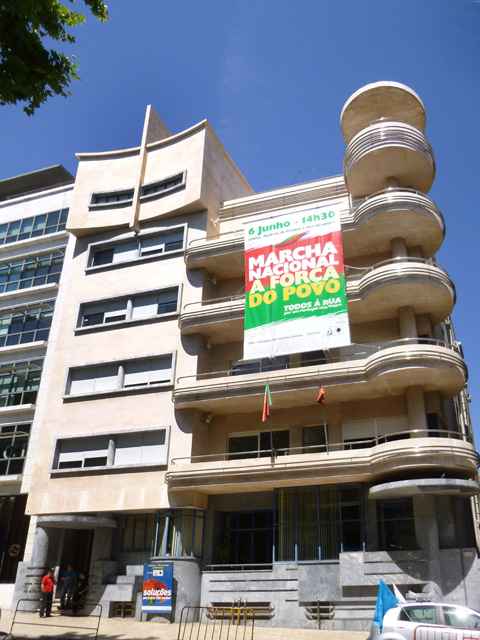
Startling modernity in Lisbon in 1936

The Victoria Hotel was designed by the tremendously talented architect Cassiano Viriato Branco, who also designed other landmark, mid-war buildings in Lisbon such as the Teatro Éden. Work began in 1934 on the project and it was completed in 1936, though this was only part of the architect’s concept.

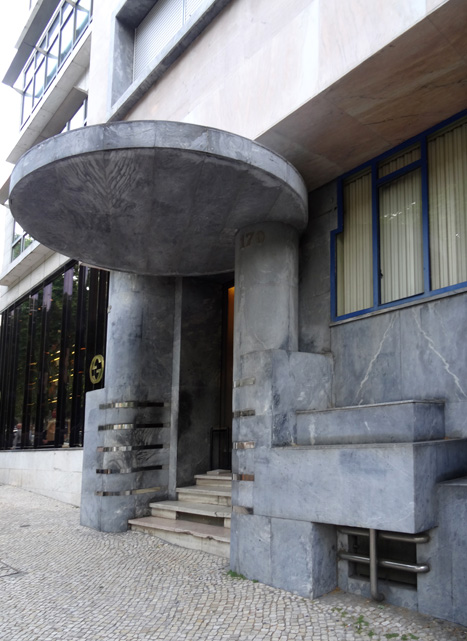
The building had a number of features, including a facing of pink marble, but the most eye-catching one was certainly the circular balconies stacked along the corner of the six-storey building. These were cleverly echoed with a round porch projecting out above the entrance.

By the mid 1970s the hotel had become run down and neglected which engendered an attempt to revive it. Nothing came of this in the end and the building was bought in 1985 by the Lisbon branch of the Portuguese Communist Party, and it remains their regional headquarters.

A striking entrance

The Barber Institute, Birmingham

The brick and stone of the Barber Institute

Many great collections of historical art are housed in Neo-Classical buildings. Up in the midlands of England there is, however, one great collection that is housed in a purpose-built Art Deco art gallery. This is The Barber Institute in Birmingham, which was founded by Henry Barber, a successful property developer, with assistance from his heiress wife, Lady Barber. Mr Barber died in 1927 and the collection and the gallery were created by Lady Barber as a fitting and permanent memorial to her husband.

Lady Barber herself passed away in 1933, but by this time she had founded the Barber Institute of Fine Arts. This was bequeathed to the University of Birmingham, and its trustees worked assiduously to bring it into existence. The architect was Robert Atkinson and the completed Institute opened in 1939, complete with galleries and a concert hall. The exterior has a mixture of Art Deco curving and traditional angular corners, and is stone-faced on the lower floors and brick-faced above. There are some stone reliefs on the exterior.

Stone relief on the upper façade
The entrance to the Barber Institute