Cinema Império, Lisbon

This former cinema features strong, vertical lines

Cinema Império – the Empire Cinema, a former cinema in Lisbon, is located at the intersection of Alameda Dom Afonso Henriques and Avenida Almirante Reis 35, Lisbon, Portugal. The Cinema Imperio was constructed between 1947 and 1952. It was designed by Cassiano Branco, one of Portugal’s great modernist architects who was responsible for the shell of the building. Frederico George was responsible for the interior and R. Chorao Ramalho for the ground floor level cafe.
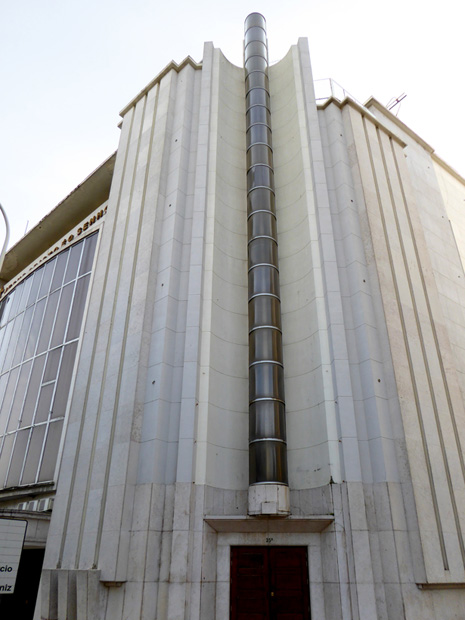
The abstract towers at the corners are striking

The Cinema Império functioned as a cinema, theatre, and concert hall in the Portuguese capital of Lisbon, opening on 24 May 1952. The cinema’s debut was on 24 May 1952 and featured the French film called ‘La Beauté du Diable’, directed by René Clair. During its three decades as a cinema it screened films such as Federico Fellini’s ‘Amarcord’ and ‘Juliet of the Spirits’ as well as ‘Jules et Jim’ by François Truffaut and films by Ingmar Bergman and Orson Welles. ‘I Cannibali’ by Liliana Cavani, ‘Rosemary’s Baby’ by Roman Polanski, and ‘55 Days at Peking’ by Nicholas Ray were among the cinema’s most successful films.

The base of an abstract tower

Closing as a cinema in December 1983, Cinema Império began a new life in 1992 as a church, like many other classic cinemas, when it was taken over by the Universal Church of the Kingdom of God

A classic marquee entrance

Up the steps to take in the details

Halford House, Leicester

The mixed façade of Halford House

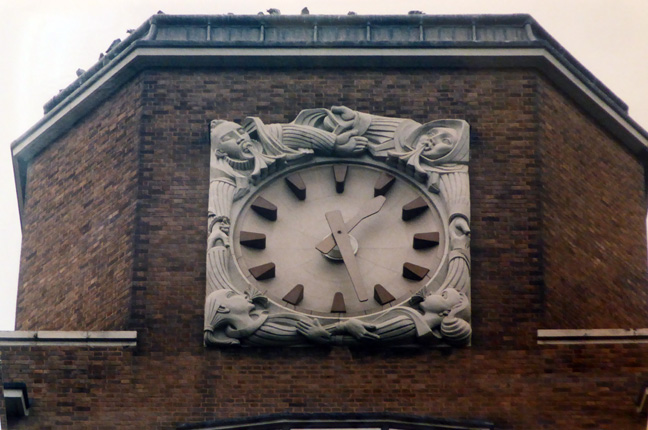
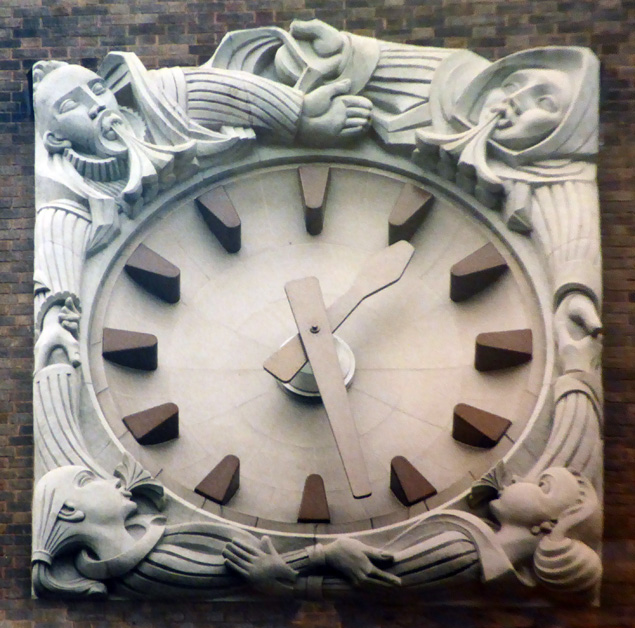
Originally constructed as headquarters on Charles Street for the Leicester Temperance Building Society, 1955-59, it was later taken over by the Alliance & Leicester Building Society. Now known as Halford House, it is in part occupied by Pick Everard Keay and Gimson, the architects who first conceived it. The building is a fascinating fusion of new norms of modernism with existing Art Deco forms, notably the central clock tower flanked by two wings, and the use of a bay window. Certainly the most striking feature is the decorative clock found top centre of the main façade. This depicts the Four Winds Blowing, and was designed by local artist and educator Albert Pountney (1915-1982).

A unity of wind power, and time
The central, hexagonal clock tower

Condes Cinema, Lisbon

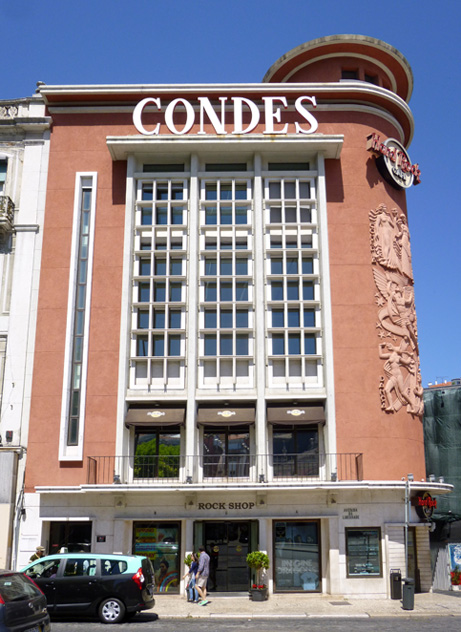
Façade of the Condes Cinema

While the Condes Cinema opened in 1951 buildings at this location of Praça dos Restauradores at Rua Condes already had a long history as theatres. First opening as the Teatro da Rua dos Condes in 1738, the theatre began its life as an opera house. It was constructed on land on land owned by the Conde da Ericeira (Count of Ericeira) by what is now known as the Rua Condes. This was a part of the city popular with the nobility, and several aristocrats had their palaces there. The theatre had to be rebuilt in 1755 after being badly damaged by the terrible Lisbon earthquake earlier that year.

A new theatre, the Teatro Novo da Rua dos Condes, was constructed in 1888 on the same location, and ten years later it  remodelled inside to increase seating capacity. Then the twentieth century and its technological marvels arrived and by 1915 theatre had been converted into a cinema. This survived for decades until 1951 when it was torn apart to make way for a purpose-built cinema, the building we see today. The architect Raul Tojal began with the shell of the previous theatre and the new cinema was able to project 70mm films. The new Condes Cinema almost survived until the twenty-first century, closing in 1997. It was converted into the Hard Rock Café, Lisbon, in 2003.

The angel of cinema
The corner location at Praça dos Restauradores

Albufeira, Portugal

A simple but effective façade

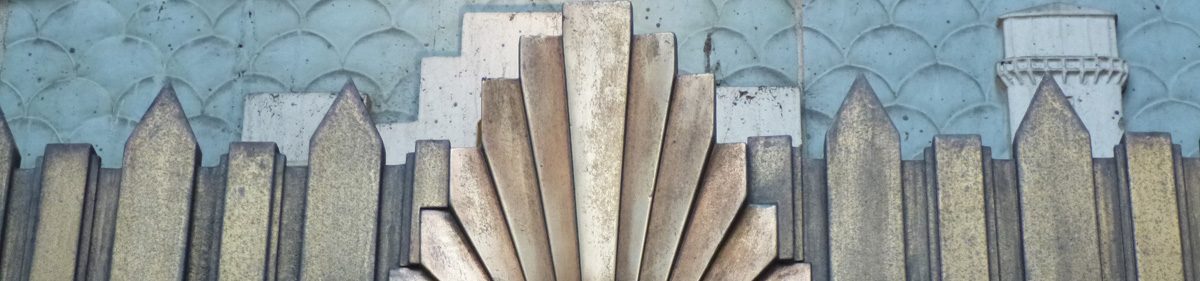
A modest, Art Deco bungalow in the seaside city of Albufeira, in the Algarve region of southern Portugal. There is a date at the top centre of the building of 8 October, 1953, and below this a series of diagonals making what could be either a zigzag or a pair of mountain peaks. Underneath all of this is a five-pointed star.

Horizontal and vertical elements at the sides

Cinema São Jorge, Lisbon

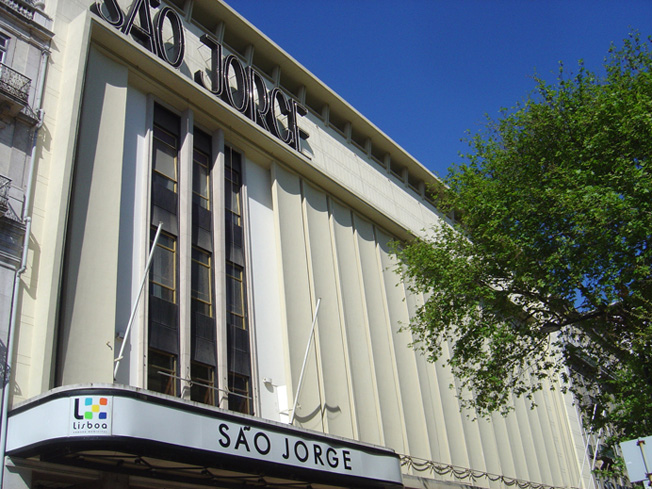
A late Art Deco cinema in Lisbon

The Cinema São Jorge (Saint George) was financed by the Rank Organisation, a British film company, and built to provide a venue to show their films. The cinema was designed by the Lisbon-born architect Fernando Silva and constructed from 1947 to 1950. Located at Avenida da Liberdade, 175, the São Jorge was at this time the biggest cinema anywhere on the Iberian peninsula. It continued to function as a cinema into the twentieth century and was taken over in 2007 by Lisbon’s City Council who have continued this, sometimes running film festivals in it.

Modern sans serif lettering
Now run by Lisbon city council