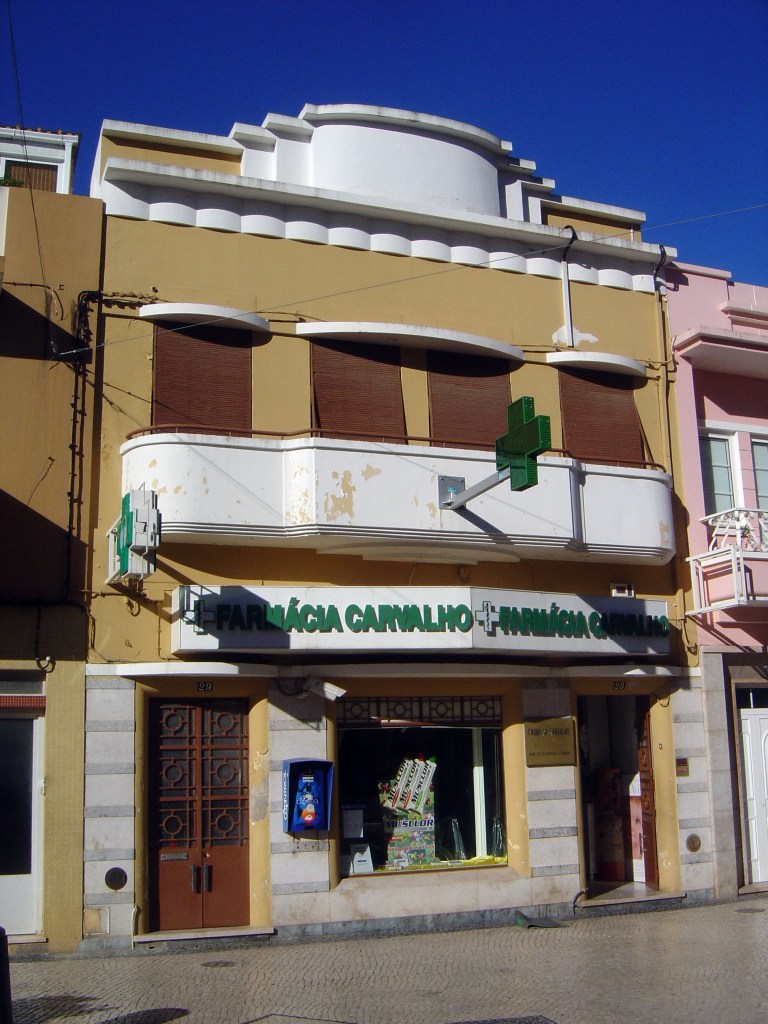
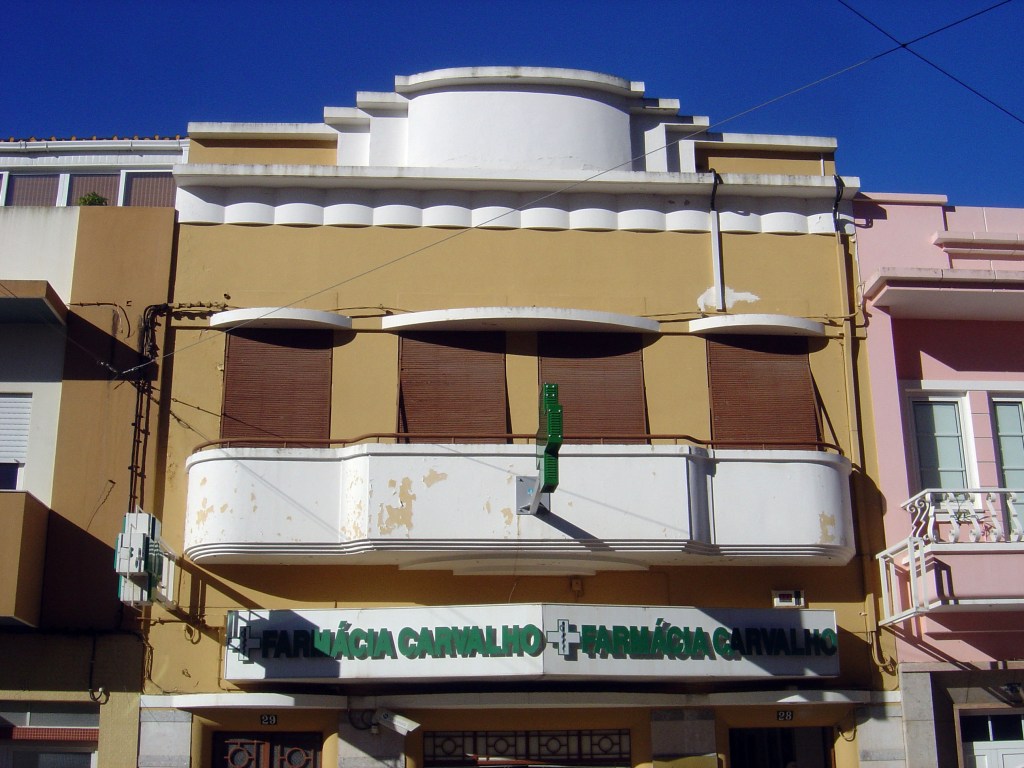
As is often the case there is no architect listed for this delightful early 20th century building., with its stepped parapet. Its proportions and curves are reflected down onto the details below.
Portimão is the second largest city in the Algarve and is sometimes referred to as its Eastern capital. Farmácia Carvalho is one of Portimão’s oldest pharmacies, having opened its doors in 1939.
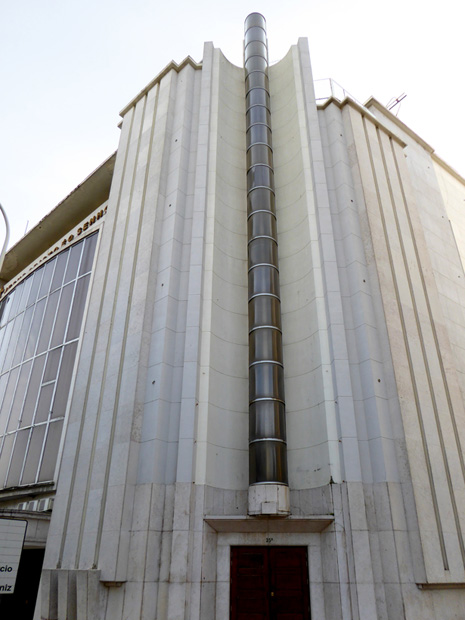
This former cinema features strong, vertical lines
Cinema Império – the Empire Cinema, a former cinema in Lisbon, is located at the intersection of Alameda Dom Afonso Henriques and Avenida Almirante Reis 35, Lisbon, Portugal. The Cinema Imperio was constructed between 1947 and 1952. It was designed by Cassiano Branco, one of Portugal’s great modernist architects who was responsible for the shell of the building. Frederico George was responsible for the interior and R. Chorao Ramalho for the ground floor level cafe.
The abstract towers at the corners are striking
The Cinema Império functioned as a cinema, theatre, and concert hall in the Portuguese capital of Lisbon, opening on 24 May 1952. The cinema’s debut was on 24 May 1952 and featured the French film called ‘La Beauté du Diable’, directed by René Clair. During its three decades as a cinema it screened films such as Federico Fellini’s ‘Amarcord’ and ‘Juliet of the Spirits’ as well as ‘Jules et Jim’ by François Truffaut and films by Ingmar Bergman and Orson Welles. ‘I Cannibali’ by Liliana Cavani, ‘Rosemary’s Baby’ by Roman Polanski, and ‘55 Days at Peking’ by Nicholas Ray were among the cinema’s most successful films.
The base of an abstract tower
Closing as a cinema in December 1983, Cinema Império began a new life in 1992 as a church, like many other classic cinemas, when it was taken over by the Universal Church of the Kingdom of God
The one on the right has a stepped zig-zag motif on its parapet
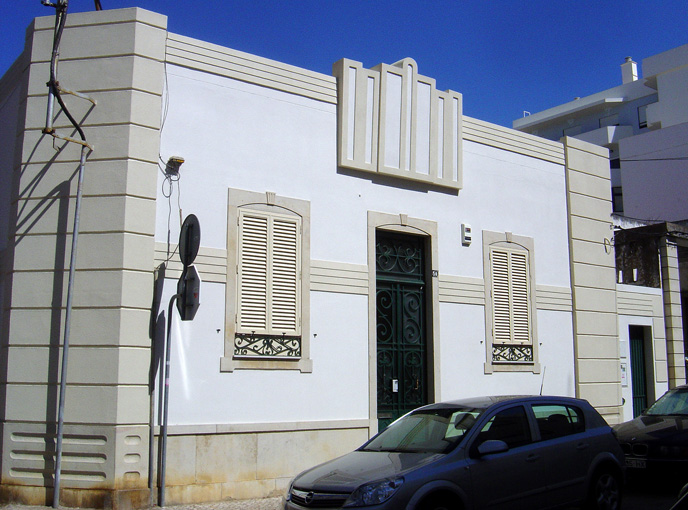
These Art Deco houses are located in Loulé, a town in the interior of Portugal’s southern Algarve region. All of them are single-storey bungalows, and it is their unique parapets which make them attractive.
A collection of vertical rectangles adorns this one
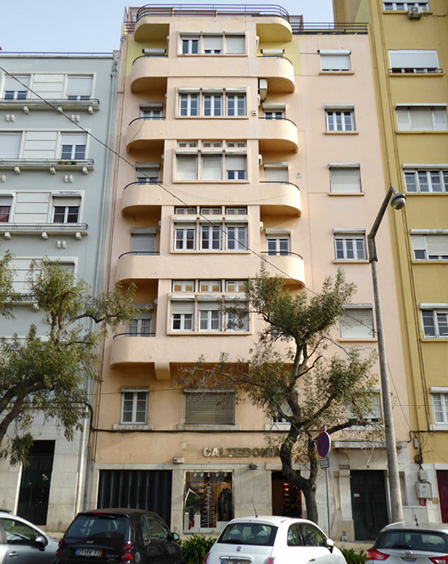
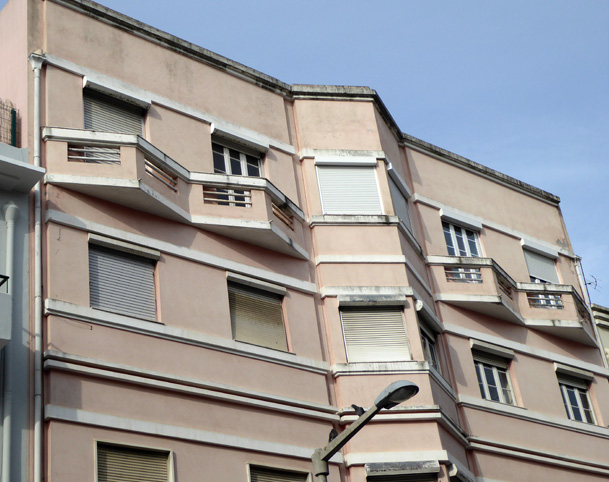
A delightful seven storey apartment block located at Avenida Guerra Junqueiro 2 in central Lisbon, in the Areeiro district, which was formerly known as the São João de Deus district. With the exception of the first floor the apartments all have central window bays with curving corner balconies. The ground floor is plain, and taken by Calzedonia, an Italian clothing store.
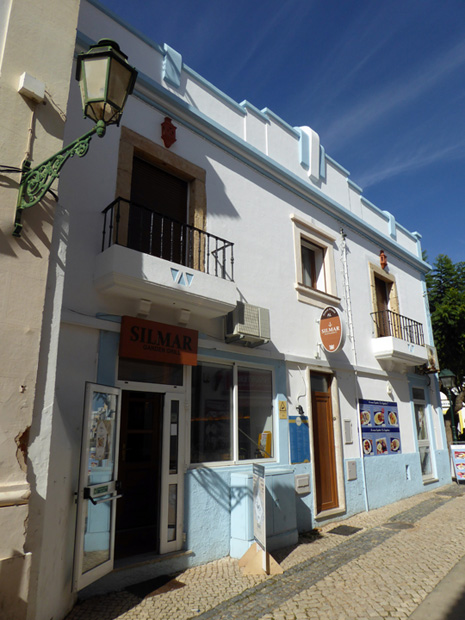
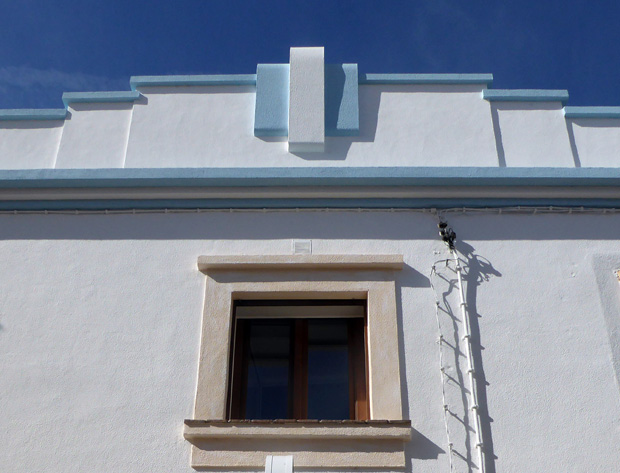
Located at Rua Marques de Pombal by the Praça Alliança, in the town of Alvor on the seaside of Portugal’s western Algarve, this blue and white two-storey building is a modest, but delightful Art Deco building. It features a parapet with a central massing, and two balconies with triangle motifs.
A rather jazzy central Lisbon apartment block from the diagonals on the main entrance to the angular features of the façade. These include the angled bay windows up the centre of the building and the small, angled balconies accompanying them, along with the white horizontal bars running across the exterior.
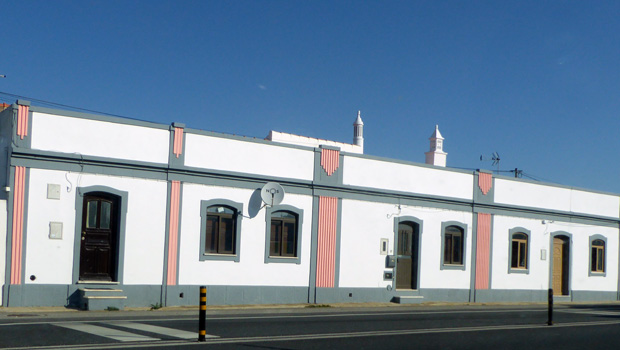
This row of nicely repainted one storey buildings was originally designed as a unity for what was probably residential purposes. Located on a busy, main road in Guia, a small town not far inland from the coast of Portugal’s Algarve, they form a part of the region’s Art Deco heritage today. There is a felicitous balance of vertical and horizontal elements.
Horizontal bars in pink are the main decorative element
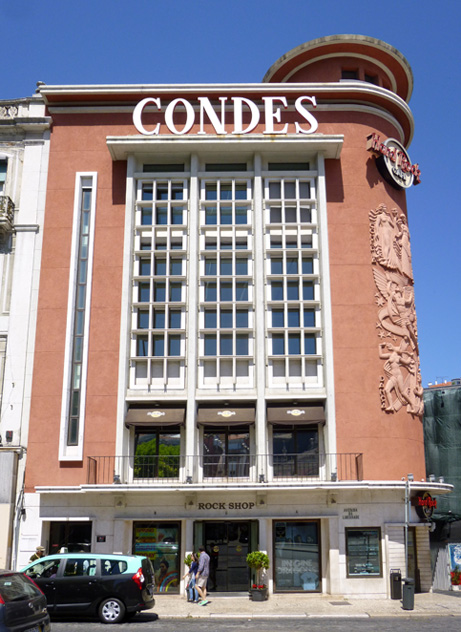
While the Condes Cinema opened in 1951 buildings at this location of Praça dos Restauradores at Rua Condes already had a long history as theatres. First opening as the Teatro da Rua dos Condes in 1738, the theatre began its life as an opera house. It was constructed on land on land owned by the Conde da Ericeira (Count of Ericeira) by what is now known as the Rua Condes. This was a part of the city popular with the nobility, and several aristocrats had their palaces there. The theatre had to be rebuilt in 1755 after being badly damaged by the terrible Lisbon earthquake earlier that year.
A new theatre, the Teatro Novo da Rua dos Condes, was constructed in 1888 on the same location, and ten years later it remodelled inside to increase seating capacity. Then the twentieth century and its technological marvels arrived and by 1915 theatre had been converted into a cinema. This survived for decades until 1951 when it was torn apart to make way for a purpose-built cinema, the building we see today. The architect Raul Tojal began with the shell of the previous theatre and the new cinema was able to project 70mm films. The new Condes Cinema almost survived until the twenty-first century, closing in 1997. It was converted into the Hard Rock Café, Lisbon, in 2003.
The angel of cinemaThe corner location at Praça dos Restauradores
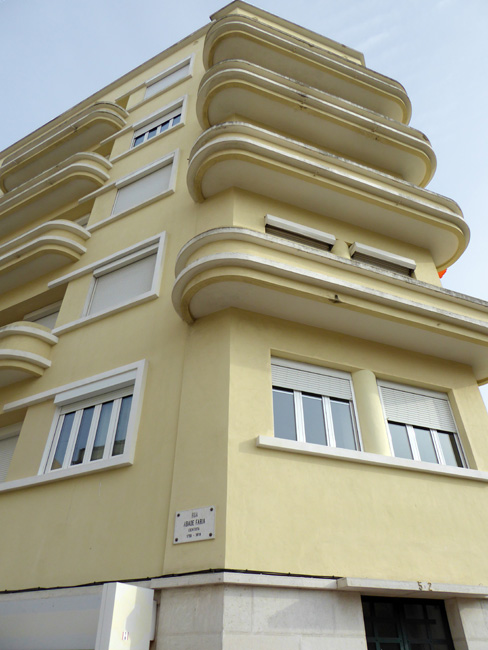
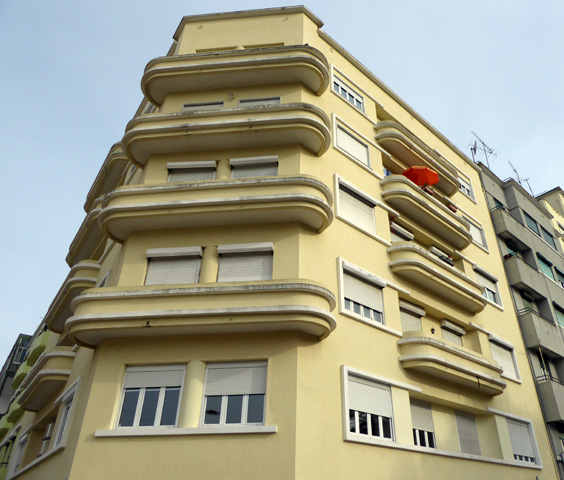
We could certainly label this Lisbon apartment building as being Streamline Moderne with its racy, curving balconies. The street it is located on is named after a fascinating character known as Abade Faria, or Abbot Faria, born in 1756 in the Portuguese Indian colony of Goa as José Custódio de Faria. Aside from being a man of the cloth he was a revolutionary, and also one of the first to study hypnotism.
The Eden Teatro, or Eden Theatre, sits on the Praça dos Restauradores in central Lisbon, and is one of Lisbon’s most spectacular cinema buildings, showing films up until 1989. Cassiano Branco and Carlo Florencio Dias were the architects responsible for this Art Deco palace, which opened in 1931. The building features a magnificent, creamy pink coloured marble façade and a floating stone frieze across the top. There is also an abundance of geometric fenestration throughout. The interior was altered when it was converted into an apart-hotel complex in 2001.
Take note of the masks mascarading as capitalsSome details of the carved frieze











 Global Art Deco