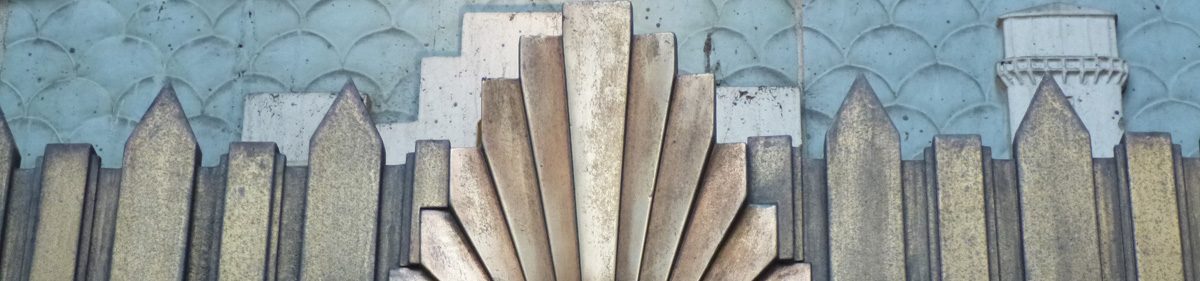
Cinema Império, Lisbon

This former cinema features strong, vertical lines

Cinema Império – the Empire Cinema, a former cinema in Lisbon, is located at the intersection of Alameda Dom Afonso Henriques and Avenida Almirante Reis 35, Lisbon, Portugal. The Cinema Imperio was constructed between 1947 and 1952. It was designed by Cassiano Branco, one of Portugal’s great modernist architects who was responsible for the shell of the building. Frederico George was responsible for the interior and R. Chorao Ramalho for the ground floor level cafe.
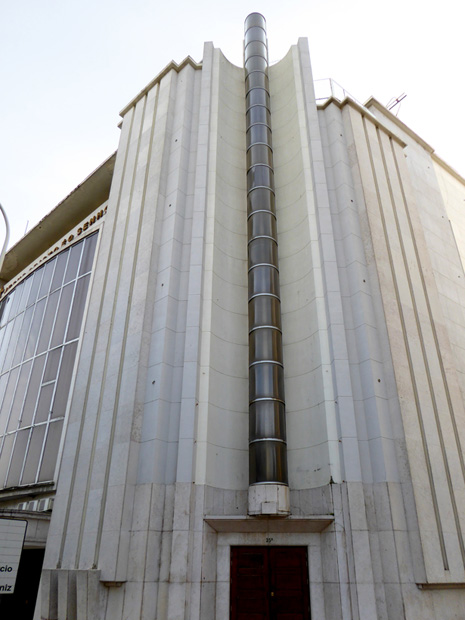
The abstract towers at the corners are striking

The Cinema Império functioned as a cinema, theatre, and concert hall in the Portuguese capital of Lisbon, opening on 24 May 1952. The cinema’s debut was on 24 May 1952 and featured the French film called ‘La Beauté du Diable’, directed by René Clair. During its three decades as a cinema it screened films such as Federico Fellini’s ‘Amarcord’ and ‘Juliet of the Spirits’ as well as ‘Jules et Jim’ by François Truffaut and films by Ingmar Bergman and Orson Welles. ‘I Cannibali’ by Liliana Cavani, ‘Rosemary’s Baby’ by Roman Polanski, and ‘55 Days at Peking’ by Nicholas Ray were among the cinema’s most successful films.

The base of an abstract tower

Closing as a cinema in December 1983, Cinema Império began a new life in 1992 as a church, like many other classic cinemas, when it was taken over by the Universal Church of the Kingdom of God

A classic marquee entrance

Up the steps to take in the details

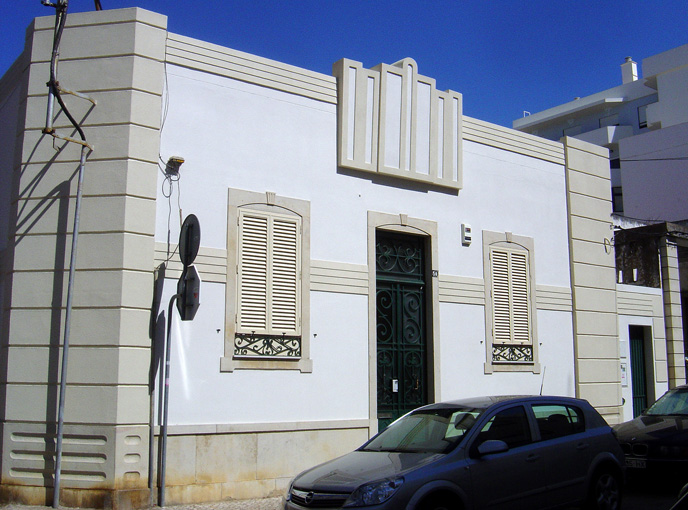
Houses in Loulé, Portugal

The one on the right has a stepped zig-zag motif on its parapet

These Art Deco houses are located in Loulé, a town in the interior of Portugal’s southern Algarve region. All of them are single-storey bungalows, and it is their unique parapets which make them attractive.

A collection of vertical rectangles adorns this one

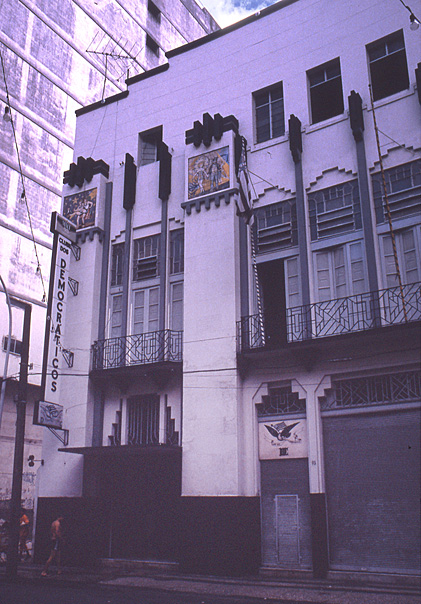
Clube dos Democráticos, Rio de Janeiro

The ‘Clube dos Democráticos’, is located on the Rua Riachuelo in the Lapa district of Rio de Janeiro. Originally a Carnival Society, the ‘Clube dos Democráticos’ was founded in 1867. In more recent times it has ceased to be a parade club organizer and has devoted itself to other Carnival related activities such as putting on shows of Samba bands. It is one of Rio’s oldest live music venues, and regularly hosts top quality samba and forro bands.

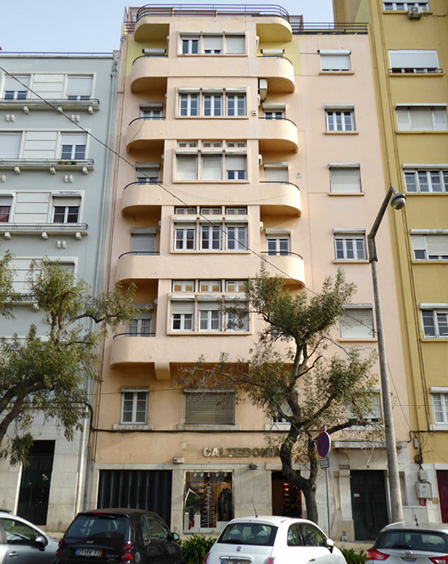
Avenida Guerra Junqueiro 2, Areeiro, Lisbon

A delightful seven storey apartment block located at Avenida Guerra Junqueiro 2 in central Lisbon, in the Areeiro district, which was formerly known as the São João de Deus district. With the exception of the first floor the apartments all have central window bays with curving corner balconies. The ground floor is plain, and taken by Calzedonia, an Italian clothing store.

A stack of Art Deco balconies and bay windows

Royal Exchange Hotel, Sydney

Horizontal bands are the main decorative feature

The Royal Exchange Hotel in Sydney be found in the city’s Marrickville district, a suburb in the inner west of Sydney. Located on a corner lot, it features period lettering around the top spelling out the name, and a parapet with horizontal and vertical decorative bands.

The parapet on the corner

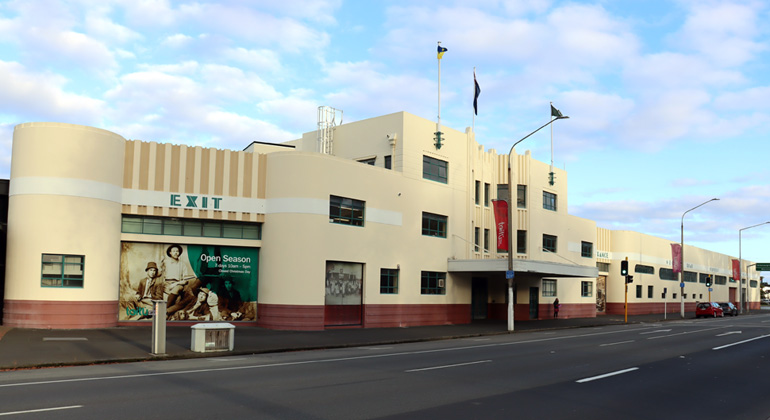
Railways Road Services Building, Dunedin

Dunedin’s former bus station

This long, horizontal edifice is the former New Zealand Railways Road Services Building in the South Island city of Dunedin. It was the city’s main bus station and garage for many decades. Located at 35 Queens Gardens, it was designed by James Hodge White and Eric Miller and constructed in 1939. The building now serves the Dunedin Otago Settlers Museum.

Art Deco features include irregular pleating above the ‘Exit’ and ‘Entrance’ found near the façade ends. It also has smooth, hemispherical curves at the ends. The upper part of the centre of the building has vertical bands topped off by crenellations. The building was registered under New Zealand’s Historic Places Act in 1980. Thanks to Robert Piggott for providing the photographs.

The central block of the builiding
Note the sawtooth line along the top

Hotel Waterloo, Wellington

A dash of the Jazz Age in the NZ capital

The 1937 Hotel Waterloo was designed by the Wellington firm of Atkins and Mitchell and was constructed for New Zealand Breweries company who wanted a luxurious, modern look. The location at 28 Waterloo Quay was close to the Wellington train station and to the ferry terminal, a strategic placing for travellers who would appreciate its fine bars. After fifty odd years of service it shut its doors in the late 1980s for a few years, only to be reborn as a backpackers’ hostel. The bands of decorative motifs consisting of chevron forms and semi-circles are still distinctive. Thanks again to Taika Kyriak for providing these photos.

The full façade of The Hotel Waterloo
The chevron forms and semicircle motifs

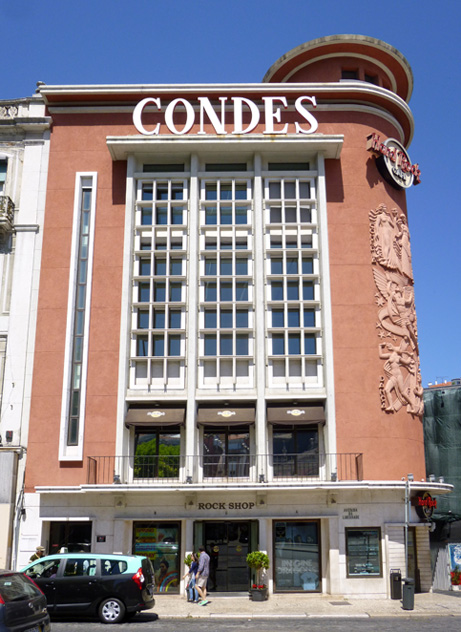
Condes Cinema, Lisbon

Façade of the Condes Cinema

While the Condes Cinema opened in 1951 buildings at this location of Praça dos Restauradores at Rua Condes already had a long history as theatres. First opening as the Teatro da Rua dos Condes in 1738, the theatre began its life as an opera house. It was constructed on land on land owned by the Conde da Ericeira (Count of Ericeira) by what is now known as the Rua Condes. This was a part of the city popular with the nobility, and several aristocrats had their palaces there. The theatre had to be rebuilt in 1755 after being badly damaged by the terrible Lisbon earthquake earlier that year.

A new theatre, the Teatro Novo da Rua dos Condes, was constructed in 1888 on the same location, and ten years later it  remodelled inside to increase seating capacity. Then the twentieth century and its technological marvels arrived and by 1915 theatre had been converted into a cinema. This survived for decades until 1951 when it was torn apart to make way for a purpose-built cinema, the building we see today. The architect Raul Tojal began with the shell of the previous theatre and the new cinema was able to project 70mm films. The new Condes Cinema almost survived until the twenty-first century, closing in 1997. It was converted into the Hard Rock Café, Lisbon, in 2003.

The angel of cinema
The corner location at Praça dos Restauradores

Calle Xativa 21, Valencia

A nine-storey mixed-use building

This 1930s apartment and commercial use building is located in the elegant Sant Francesc area of central Valencia on Calle Xativa, across from the Valencia North train station. It folds around a corner lot and has upper divisions, though these are not fully stepped in. There are some excellent Art Deco carved relief panels on the horizontal interstices of the windows. One of these depicts a modern sun god with a gear wheel representing the sun.

The upper part of the edifice
Carved stone relief panels
An exuberant, flowing image of a sun god