Enmore Theatre, Sydney

Warm colours and Jazz Age lettering

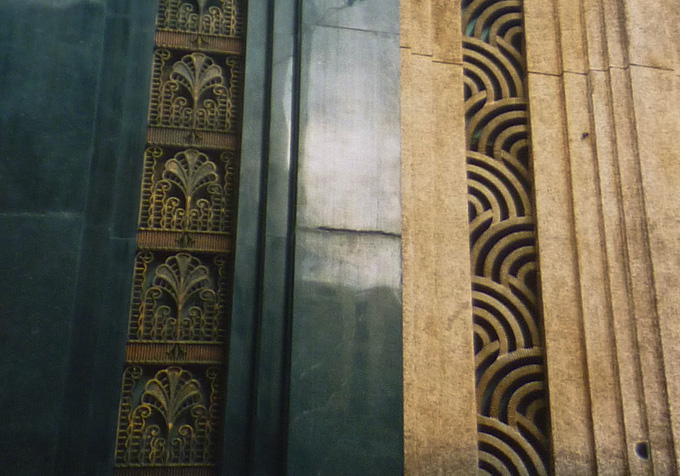
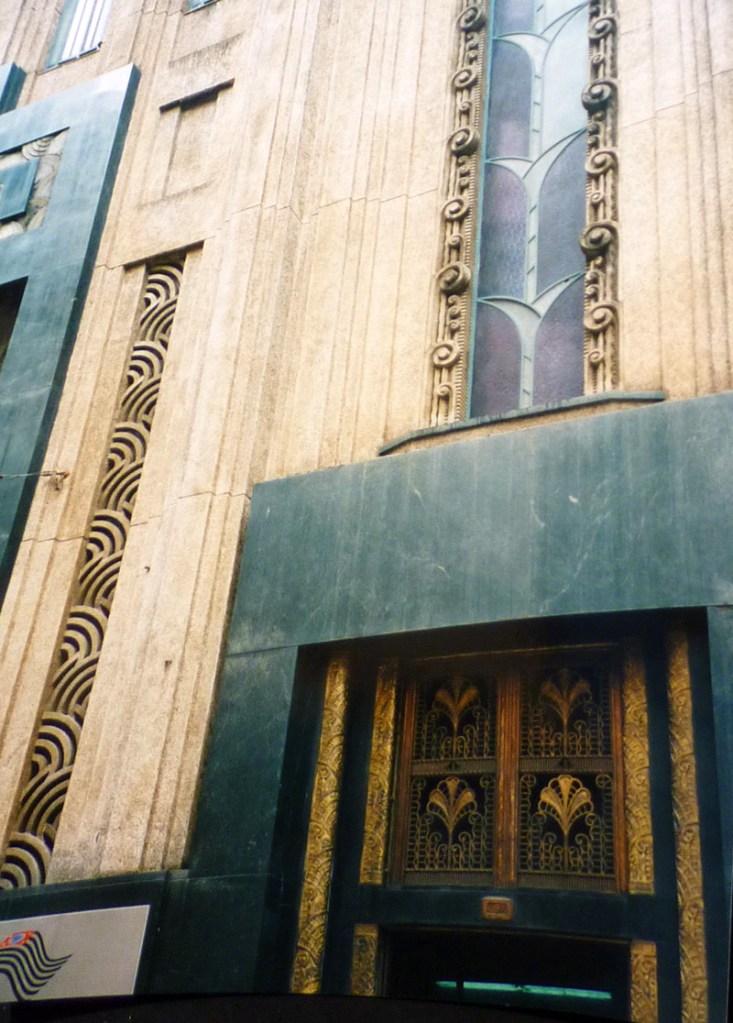
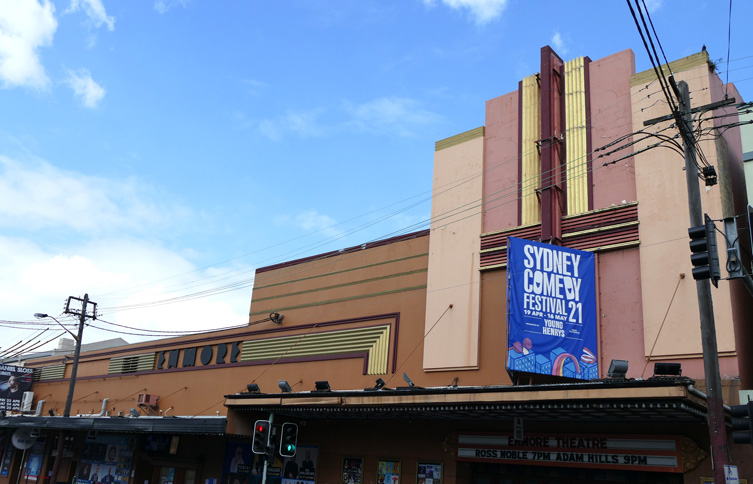
With this post we are once more off to the theatre. In fact, the Enmore Theatre is not only the longest running one in Sydney, Australia, but also the only surviving Art Deco styled theatre there. It can be found in the Newtown area at 118-132 Enmore Road and was first built in 1908, opening in 1912 as a cinema for silent movies with a concert orchestra providing their soundtracks. The Enmore was designed by the architects Kaberry & Chard and renovated in 1920, but this is a bit early for the geometric styling we see here. It was probably renovated again in the 1930s.

The Enmore is still going strong in its second century of theatre and cinema existence and can fit 1,700 seated and 2,500 standing. It has always balanced big name acts like Bob Dylan and the Rolling Stones with native Australian acts and local events. This may well have been the key to its survival as the arrival of television saw the closing and demolition of many fine entertainment houses globally. Many thanks to Keith Barrett for providing these photographs.

Horizontal and vertical juxtapositions in pastel tones
Another view of the Enmore Theatre’s façade

Albufeira, Portugal

A simple but effective façade

A modest, Art Deco bungalow in the seaside city of Albufeira, in the Algarve region of southern Portugal. There is a date at the top centre of the building of 8 October, 1953, and below this a series of diagonals making what could be either a zigzag or a pair of mountain peaks. Underneath all of this is a five-pointed star.

Horizontal and vertical elements at the sides

Alameda Beers, Valencia

Alameda Beers
A finely detailed exterior

Located at Paseo de la Alameda 15 at the corner of Calle de Don Armando Palacio Valdés, in central Valencia, this curved corner building is a mixture of commercial and residential. The Alameda Beers restaurant occupies the ground floor.

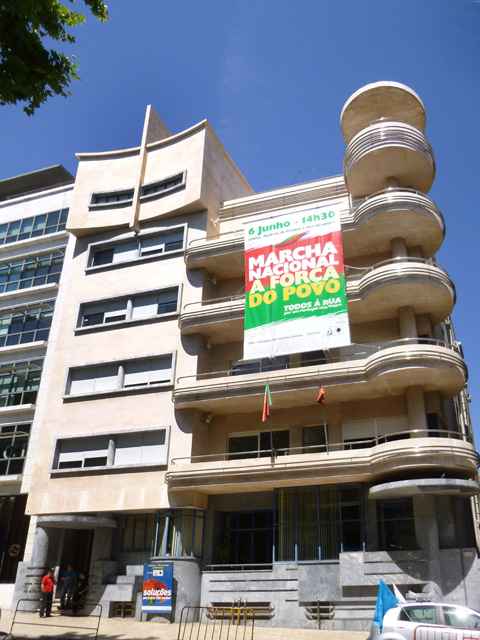
Victoria Hotel, 170 Avenida da Liberdade, Lisbon

Startling modernity in Lisbon in 1936

The Victoria Hotel was designed by the tremendously talented architect Cassiano Viriato Branco, who also designed other landmark, mid-war buildings in Lisbon such as the Teatro Éden. Work began in 1934 on the project and it was completed in 1936, though this was only part of the architect’s concept.

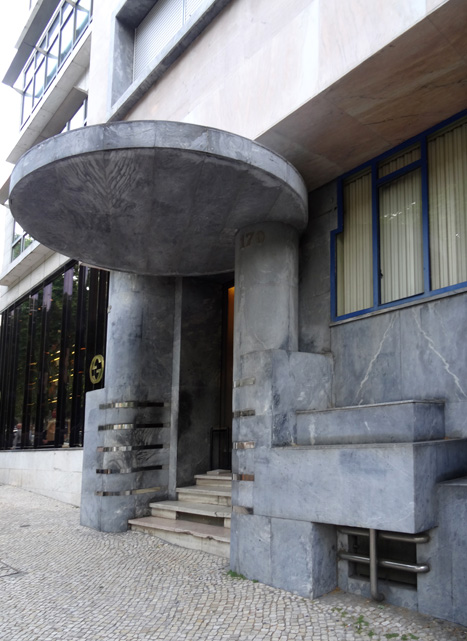
The building had a number of features, including a facing of pink marble, but the most eye-catching one was certainly the circular balconies stacked along the corner of the six-storey building. These were cleverly echoed with a round porch projecting out above the entrance.

By the mid 1970s the hotel had become run down and neglected which engendered an attempt to revive it. Nothing came of this in the end and the building was bought in 1985 by the Lisbon branch of the Portuguese Communist Party, and it remains their regional headquarters.

A striking entrance

The Barber Institute, Birmingham

The brick and stone of the Barber Institute

Many great collections of historical art are housed in Neo-Classical buildings. Up in the midlands of England there is, however, one great collection that is housed in a purpose-built Art Deco art gallery. This is The Barber Institute in Birmingham, which was founded by Henry Barber, a successful property developer, with assistance from his heiress wife, Lady Barber. Mr Barber died in 1927 and the collection and the gallery were created by Lady Barber as a fitting and permanent memorial to her husband.

Lady Barber herself passed away in 1933, but by this time she had founded the Barber Institute of Fine Arts. This was bequeathed to the University of Birmingham, and its trustees worked assiduously to bring it into existence. The architect was Robert Atkinson and the completed Institute opened in 1939, complete with galleries and a concert hall. The exterior has a mixture of Art Deco curving and traditional angular corners, and is stone-faced on the lower floors and brick-faced above. There are some stone reliefs on the exterior.

Stone relief on the upper façade
The entrance to the Barber Institute

Avenida Sidonio Pais 18, Lisbon

Façade of Avenida Sidonio Pais 18

Sitting just opposite Lisbon’s expansive Parque Eduardo VII (Edward VII Park, named in honour of the UK monarch who visited Portugal in 1903), the building at Avenida Sidonio Pais 18 is one of a cluster of contiguous structures which probably all had the same team of architects. These are most likely buildings from the 1940s and nearly all of them have at least a sculpture over the main entrance.

Avenida Sidonio Pais 18 is a modern building with a Classical touch not only in the window pediments on the exterior but also in its ambitious sculpture programme. On either side of the front entrance are vertical groups of four carved, stone reliefs. These depict in fine Art Deco style eight of the nine Muses, those Classical personifications of the arts and knowledge including Clio, the Muse of history and Euterpe, the Muse of flutes and lyric poetry.

Stone reliefs of the Muses by the front entrance
Clio, the Muse of history
Euterpe, the Muse of flutes and lyric poetry

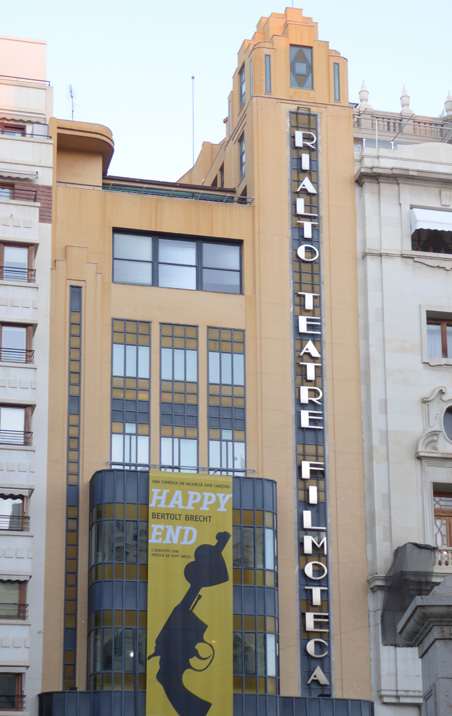
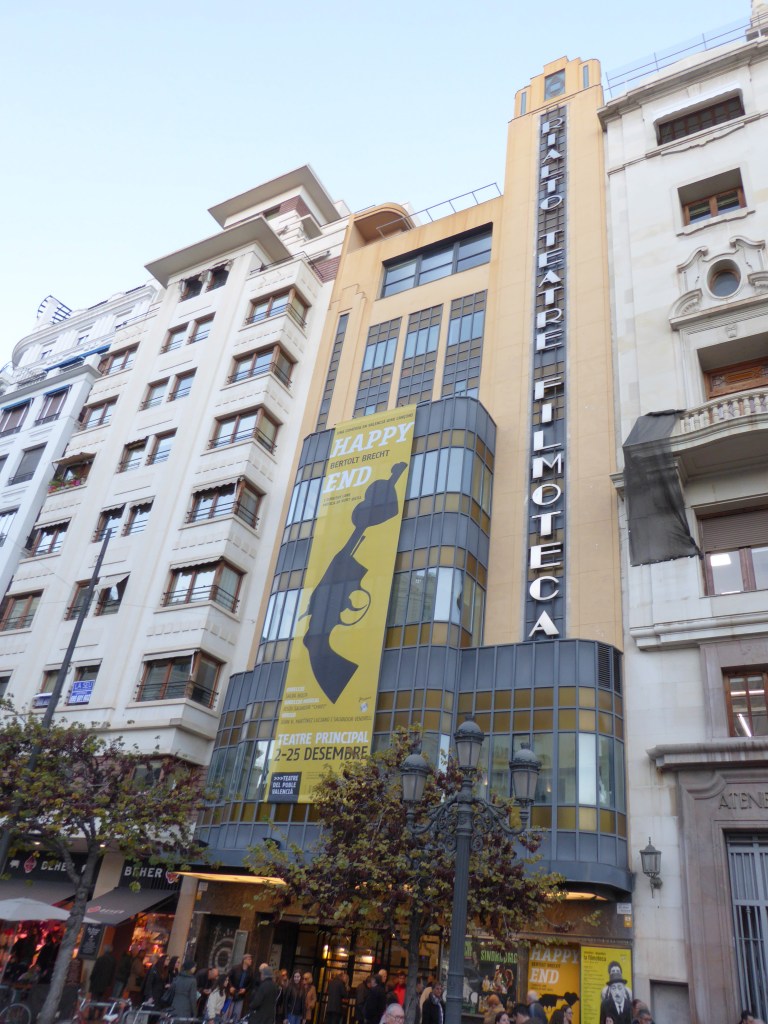
Teatro Rialto, Valencia

Grids of windows on the Teatro Rialto

If you should visit the Spanish seaside town of Valencia you might discover the marvellous Teatro Rialto there. Located in Plaza del Ayuntamiento (Town Hall square) in the central city area, it was designed by the architect Cayetano Borso di Carminati and constructed in 1939. Originally a cinema, it was taken over by the Valencian government who converted it into a theatre in the 1980s. It also has a screening hall for the local government’s film library. The Teatro Rialto makes an interesting comparison with the Kaaitheater in Brussels: https://globalartdeco.com/art-deco-cities/brussels-2/

The complete façade

Department of Tourism, São Paulo

View of part of the façade

The building where the Department of Tourism of the State of São Paulo (Secretaria de Turismo do Estado de São Paulo) now resides was originally constructed for the 1938 Banco de São Paulo. Located at Praça Antonio Prado 9, it was designed by the architect Álvaro de Arruda Botelho. This building is composed of two interconnected wings, one twelve storeys high and the other sixteen. The façade is extensively decorated with Art Deco designs created from materials such as granite, marble, and bronze.

A metal window grill with plant forms
A variety of Art Deco motifs
Another view of the lower façade

Berea Court, Durban

The bright façade of Berea Court

We are fortunate to have another guest post from the Durban Art Deco Society. Durban is South Africa’s third largest city and has many fine Art Deco buildings, including this one.

Berea Court

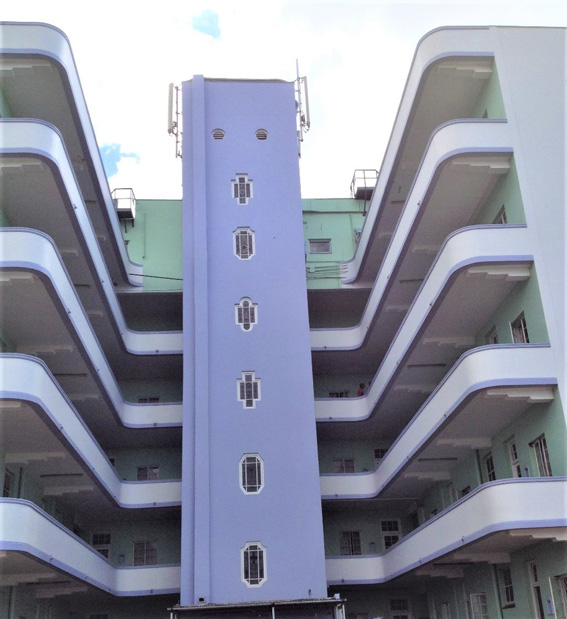
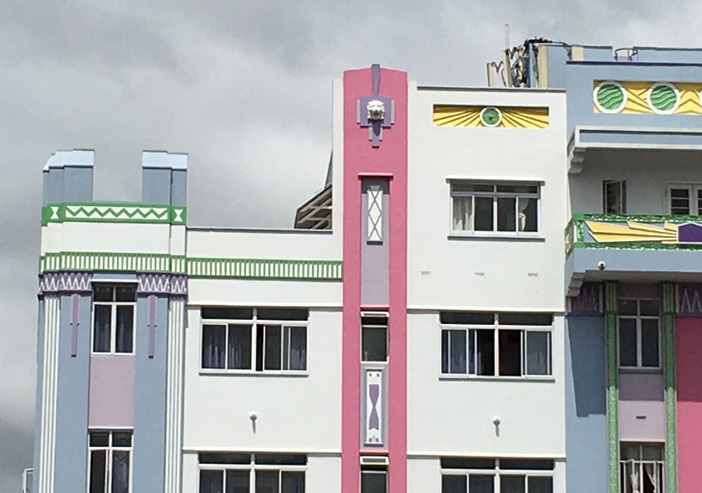
This is a multi-storey 41-apartment building with excellent detailing, designed for the Langton family by Alfred Arthur Ritchie McKinlay around 1930 and located at 399 Berea Road. The stucco finish has good mouldings in authentic Art Deco style. A stylised theme of wings is evident in the design, with geometric string courses. The central balcony at high level is richly decorated with a sunburst pattern and forms a high level focus to Berea Road.

Fluted pilasters rise through the façade to a crenellated parapet with lion features.  The entrance below has an African feel to the surround mouldings. There is a well-designed rear elevation with cantilevered walkways and an amusing range of stained glass windows to the lift shaft, and flat entrances, which have original milk-bottle alcoves. The top floor is open for water tanks and the lift shaft.

The building is used for student accommodation and is well maintained by the owner.

The superb, African styling of the main entrance
An original stained glass window at Berea Court
Streamlined balconies at the back
A detail of the top of Berea Court

Photos and text © Durban Art Deco Society

Cinema São Jorge, Lisbon

A late Art Deco cinema in Lisbon

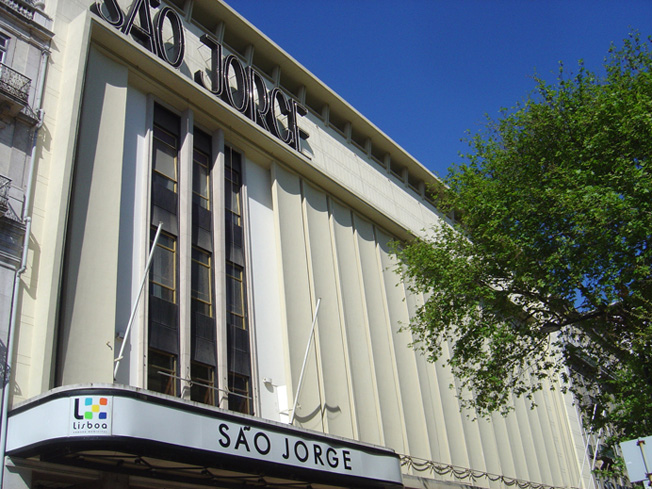
The Cinema São Jorge (Saint George) was financed by the Rank Organisation, a British film company, and built to provide a venue to show their films. The cinema was designed by the Lisbon-born architect Fernando Silva and constructed from 1947 to 1950. Located at Avenida da Liberdade, 175, the São Jorge was at this time the biggest cinema anywhere on the Iberian peninsula. It continued to function as a cinema into the twentieth century and was taken over in 2007 by Lisbon’s City Council who have continued this, sometimes running film festivals in it.

Modern sans serif lettering
Now run by Lisbon city council